Tether Training Done Right: How a Short Line Can Build a Calmer Dog
Forget the rusty chain in the yard — modern tethering is a structured, humane method that teaches puppies and adult dogs to settle on their own.
The Rusty Chain Is Not What We're Talking About
For decades, tethering a dog conjured one image: a lonely hound on a corroded chain, guarding a yard it never left. That practice was neglect, and it left scars on generations of dogs and on the public's trust in the word itself. Modern tether training shares almost nothing with that history. Today's method means attaching a dog to a fixed object or a stationary person for a defined, short period — minutes, not hours — with the handler present, rewards flowing, and a clear behavioral goal in mind. The shift matters because a well-tethered dog gains a skill that a chronically chained dog never had: the ability to relax without roaming. Service-dog programs have relied on this distinction for years, and pet owners are catching up. Understanding the difference between isolation on a line and structured proximity training is the first step toward using tethering as a legitimate tool.
Why Trainers Reach for a Tether
The core aim of tether training is to teach a dog to be comfortable in situations where free movement is off the table. Think of a vet waiting room, a sidewalk café table, or a living room where the family is gathered around the television. Each scenario asks the dog to do something unnatural — stay put while the world happens around it. A tether provides a gentle, physical boundary that makes the lesson concrete. For puppies specifically, tethering to the owner doubles as a housebreaking aid much like a crate: the puppy is far less likely to urinate or defecate while physically connected to its human, and the handler is positioned to notice restlessness and respond before an accident happens. Attention-seeking dogs also benefit because the tether teaches them that brief separation from physical contact does not signal abandonment — a lesson that shortens the path to calmer evenings and fewer demand barks.
Where Tethering Pays Off in Daily Life
A dog that settles calmly on a tether can accompany its owner to outdoor urban restaurants, farmers' markets, and sporting events without being at risk from traffic or underfoot crowds. That expanded social life benefits both dog and owner. Tethering also offers an alternative to crating for households where a dog needs to be stationary for fifteen or twenty minutes while a parent cooks dinner or helps a child with homework. Because the dog remains in the room rather than behind a wire door, it continues to absorb household routines — a subtle but real advantage for socialization. Evening downtime is another win: tethered near the family sofa, a dog that once jumped or paced can practice lying on a mat while adults talk, children read, or a movie plays. Each calm rep is a deposit in the dog's behavioral bank, and over weeks those deposits compound into a noticeably more settled pet.
The Risks Nobody Should Ignore
Every training tool carries potential for misuse, and tethering is no exception. The most serious danger is physical: a dog left alone on a tether indoors or outdoors can twist, wrap, and ultimately strangle itself, even when swivel hardware is used. A tether also becomes hazardous when it is too long, allowing the dog to build speed before it hits the end — the same jarring impact that makes retractable leashes a source of neck injuries. Attaching a tether to a lightweight object such as a garden chair creates a different nightmare: the dog bolts, the chair crashes behind it, and panic feeds on itself. Beyond the mechanical risks, there is the human failure of duration. A dog tethered for hours without interaction, training, or relief is being isolated, not educated. The line between a training session and confinement is measured in minutes, and crossing it turns a useful technique into quiet cruelty.
Five Non-Negotiable Safety Rules
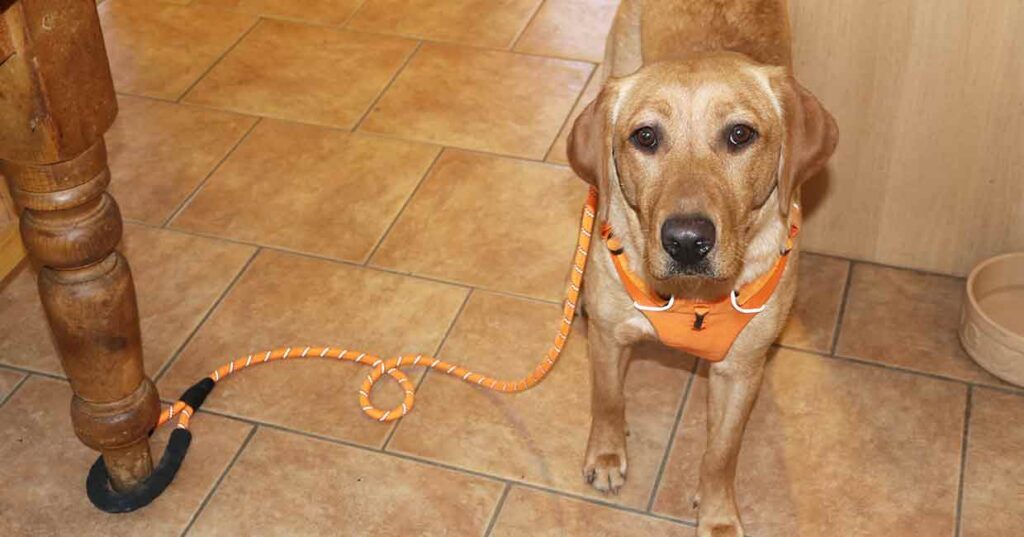
Rule one: never leave a tethered dog unattended — not in the yard, not in the house, not for a quick errand. Rule two: always clip the tether to a well-fitting harness, never to a slip lead, choke chain, or any collar that tightens under pressure. Rule three: use a fixed-length tether short enough that the dog can lie down comfortably but cannot sprint; a training leash or long line is not a substitute and teaches the dog to be obedient only when a lead is attached. Rule four: make sure the anchor point cannot move — a fence post or heavy furniture leg works; a patio chair does not. Rule five: introduce the tether gradually through formal training rather than snapping it on a dog that has never worn one. A puppy panicked by a sudden restriction may injure itself thrashing, and the resulting fear association can take weeks to undo. Each rule exists because real incidents — tangled legs, panicked bolts, collapsed chairs — have taught owners what can go wrong.
A Step-by-Step Start You Can Try This Week
Begin with the dog tethered and you sitting beside it — on the floor, in a chair, or on the couch. Keep a handful of small treats. Ignore any fussing and quietly reward the moments the dog sits or lies down. The first session can be as short as three to five minutes; end on a calm note. Over several days, tether the dog where it can see you but not touch you — across the kitchen while you cook, for instance — and reward settling. Gradually increase the distance and the duration. When you move the exercise outdoors, sprinkle a few treats on the ground around the tether point the first few times to build a positive association with the new environment. The entire progression, from first indoor session to a relaxed dog at a café table, can take two to four weeks of short daily practice. The key is to set the dog up to succeed: brief sessions, generous rewards, and an incremental increase in difficulty that never pushes the dog past its current comfort zone.
Compiled from published reference material: www.thelabradorsite.com