Six Minutes to Shine: Inside the 2024 AKC Trick Dog National Competition
The country's best trick-performing dogs will compete virtually this fall — and any Elite Performer titleholder can throw a hat in the ring.
A Stage Without Walls
Your dog already knows the routine. The living room has been the rehearsal hall for months. Now the American Kennel Club is handing out the national spotlight anyway — no cross-country road trip, no hotel that charges extra for pets, no stressful convention-center noise. The 2024 AKC Trick Dog National Competition is fully virtual: film your dog's best performance, upload the video, and let three appointed judges do the rest. Entries open August 1, 2024, and close October 1, 2024, giving handlers a tight two-month window to polish, shoot, and submit. The winner will be announced in November 2024, along with two semi-finalists who will each take home trophies. It is the kind of competition that rewards craft over geography — a Border Collie in rural Montana and a Papillon in a Brooklyn apartment compete on identical footing.
What Judges Are Actually Scoring
The AKC has not published a granular public rubric for this specific event, but the broader Elite Performer framework offers strong clues. Judges evaluate originality of tricks, difficulty relative to the dog's breed and size, the flow between elements, and how clearly the chosen theme ties the routine together. A Dachshund weaving through a miniature agility course while "starring" in a detective story will score differently than a Dachshund performing the same weave poles without narrative context. Handler–dog connection also factors in: visible teamwork, smooth cue delivery, and the dog's apparent willingness all influence perception. Three judges review each submission independently, which means a single outlier score will not sink — or crown — anyone. Handlers who have competed in prior years have noted that routines which feel like a genuine performance, rather than a checklist of tricks, tend to rise.
Prizes, Breed Bragging Rights, and What Every Qualifier Takes Home
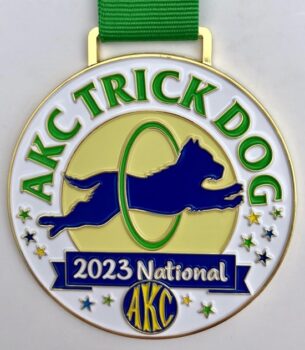
The winner and two semi-finalists receive trophies, but the reward structure goes deeper than the podium. Every qualifying entry earns a 2024 AKC National Trick Dog competition medal — a physical keepsake that marks the dog's participation at the national level. Breed prizes add another layer: the competition names a Best Trick Dog for each represented breed, meaning a Staffordshire Bull Terrier need not outperform a Border Collie overall to claim a title worth framing. Qualifying rosettes round out the haul. For handlers weighing whether the effort of filming a polished six-minute routine is worth it, the answer lies in that medal and the breed-specific recognition. Every dog that clears the qualifying threshold — regardless of whether it reaches the final three — walks away with tangible proof of national-caliber performance.
Filming Tips That Separate Good From Great
A virtual competition lives or dies on video quality, and handlers who treat the submission like a backyard home movie will find themselves at a disadvantage. Steady camera placement matters: a tripod or stable surface eliminates the shaky-hand effect that distracts judges from the dog's work. Lighting should be bright and even — outdoor daylight on an overcast day often outperforms indoor fluorescents that cast harsh shadows. Audio is trickier; if the routine relies on music, ensure the track is audible without drowning out any spoken cues the judges need to hear. Film in landscape orientation at the highest resolution available on the device. Rehearse the full routine with the camera rolling at least twice before the take that gets submitted — the first dry run almost always reveals a prop out of frame or an angle that clips the dog's paws. Handlers have until October 1, 2024 to get it right, but waiting until the final week means living with whatever the last-minute shoot delivers.
Compiled from published reference material: www.akc.org