The Redneck Girls' Agility Triumph: 7 Factors Behind Their Championship Win
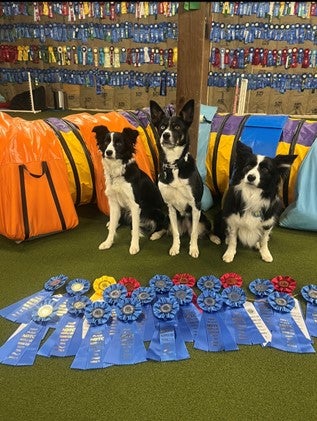
Gloria Krueger's all-female Border Collie squad outpaced 25 teams and 128 dogs in the Fall 2023 Agility League's toughest division, showcasing the strategy and skill behind their success.
2. SodaPop Will Beat You to Every Jump Unless You're Already There
Krueger calls SodaPop — formally MACH Bram Stoker's All That Fizzles MXB MJS XF T2B — her "racehorse." At four years old, the Border Collie locked down the No. 2 spot in the 20-inch regulation individual dog placement. Her defining trait is that she reads course cues instantly, which means if Krueger is even a half-step late delivering directional information, SodaPop has already committed to an obstacle — and it may not be the right one. "If we make a mistake on a course, it's usually because I did not give her the cue in time," Krueger says. Running PhD-level courses with a dog this fast demands the handler think two obstacles ahead while physically sprinting to stay within signaling range.
3. The Kid Has Zero Impulse Control, and That Changes Everything
Krueger acquired The Kid — registered as Cordova Mall MX MXJ OF T2B ACT1 CG TKA — as an adult dog, and the five-year-old earned No. 3 in the 16-inch regulation individual placement. But running her is nothing like running the other three Border Collies. "She has no impulse control," Krueger says. "I have to stay in front of her on course at all times, or she will just take any obstacle she sees." That constraint flips standard handling strategy. Most experienced handlers work to stay behind fast dogs to direct them; with The Kid, Krueger has to be physically ahead the entire run. The tunnel-under-the-dog-walk sequences in certain Standard courses were especially demanding — The Kid needed Krueger's visible presence to keep her from veering off into whatever obstacle caught her eye first.
Whoa-Nelly Earned the No. 1 Spot — and Every Ounce of It
At just 2 years old, Whoa-Nelly — registered as Barkham Asylum's Crazy Horse AX AXJ — runs so fast that Krueger cannot physically stay ahead of her on course. "I have got to hold on to those reins because if I lose my connection with her, I will lose control of her," Krueger says. Unlike SodaPop, whose mistakes usually trace to Krueger not giving the cue in time, Whoa-Nelly simply outruns her handler's ability to give physical cues at all. On PhD courses stretching up to 245 yards, Krueger has to think, sprint, and deliver directional commands from behind because the dog will not wait. What that looks like in practice: Krueger commits to staying connected through voice and motion even when she physically trails behind, issuing commands from positions she would never reach in time if Whoa-Nelly were anything less than perfectly responsive. The registered name hints at the temperament — "Crazy Horse" — and through six rounds of competition, the performance matched it.
5. Back-Side Jumps Punish Slow Handlers More Than Any Other Obstacle
The PhD courses introduced a technical wrinkle that trips up even seasoned teams: back-side jumps. Unlike a standard approach where the dog takes the jump from the front, these require the handler to push the dog to the back of the jump and clear it from the opposite direction. "If you are not fast enough, the dog will take the front side and you are off course," Krueger says. The maneuver demands precise spatial awareness — the handler has to position their body to block the front approach while simultaneously cueing the dog to wrap around. On courses running 220-plus yards with four Border Collies capable of sub-20-second times, even a single mistimed back-side jump can unravel an otherwise clean run. It's the kind of obstacle that separates PhD handlers from Senior-level ones.
6. A Tunnel Under the Dog Walk Forced Independent Dog Work
Several Standard courses in the Fall 2023 season included a configuration where a tunnel ran directly beneath the dog walk, forcing the handler to send the dog through the tunnel and toward the next obstacle without physically accompanying it — because the dog walk structure blocked the handler's path entirely. "Verbal cues definitely came in handy," Krueger says. This setup tests whether a dog can execute a sequence without handler proximity, something that varies sharply by dog. SodaPop, with her quick cue-reading, handled it cleanly. The Kid, who needs Krueger physically in front of her at all times, found it far more demanding. The configuration appeared across multiple rounds in the 12-week session, which alternated new courses every other week between Standard and Jumpers with Weaves formats.
7. Four Female Border Collies, Ages 2 to 9, Each Demanded a Different Strategy
The Redneck Girls roster — Whoa-Nelly (2), SodaPop (4), The Kid (5), and a fourth Border Collie up to age 9 — presented Krueger and Lyle with four distinct handling puzzles on every course. Whoa-Nelly requires being held on a tight line or she bolts past cues. SodaPop needs cues delivered a fraction of a second early or she self-corrects into wrong obstacles. The Kid has to see her handler in front of her or she takes whatever catches her eye. Running all three plus a fourth dog across six rounds of PhD-level courses meant Krueger couldn't settle into one handling rhythm — she had to mentally reset her timing and positioning strategy between each dog, every round. The team outperformed 25 other squads and 128 individual dogs with that adaptive approach.
8. The Championship at Purina Farms Is What Keeps Teams Logging Scores All Season
The AKC Agility League runs entirely at home facilities — teams of three to eight dogs train locally and submit scores across six rounds over 12 weeks. There's no live opponent across the ring, no crowd noise, no judge in your peripheral vision. The culminating event that gives the whole structure its competitive charge is the AKC Agility League Championship held each August at Purina Farms in Gray Summit, Missouri. Krueger's Spring 2023 team, Fastest Dogs in Dixie, took second place in the Regular Senior Division at the 2023 Championship. "It was a lot of fun to meet all these teams from around the country in which we only knew their names and scores on paper," she says. Redneck Girls plan to sit out the Winter 2024 season and return for spring competition ahead of the August Championship.
Compiled from published reference material: www.akc.org