Your Dog Is Obsessed With Food — Here's How to Outsmart the Weight Gain
Labradors and other food-driven breeds pack on pounds quietly, but a handful of practical strategies can turn the tide without turning mealtime into a battle.
Score Your Dog Before You Count a Single Calorie
Before adjusting portions, grab a baseline. The Body Condition Score (BCS) system, introduced by veterinary nutritionists in 1997 and standardized by the World Small Animal Veterinary Association, assigns every dog a number from 1 to 9. A score of 1 describes an emaciated animal; 9 marks gross obesity; and 5 is the ideal midpoint — ribs easily felt with light pressure, a visible waist when viewed from above, and a tucked abdomen in profile. The WSAVA publishes a free PDF chart with side-by-side diagrams for each score, and it is worth printing. Run your hands along your dog's ribcage: if you have to press hard to feel individual ribs, the score is likely 7 or above. If ribs are visible from a distance, you are looking at a 3 or lower. Inter-rater reliability is high enough that two different assessors rarely disagree by more than a point, which makes the system useful even for non-professionals. Record the starting number and the date, then reassess every four weeks. Movement of even one point in the right direction over a month signals meaningful progress.
Slow the Bowl Down to Stretch the Joy
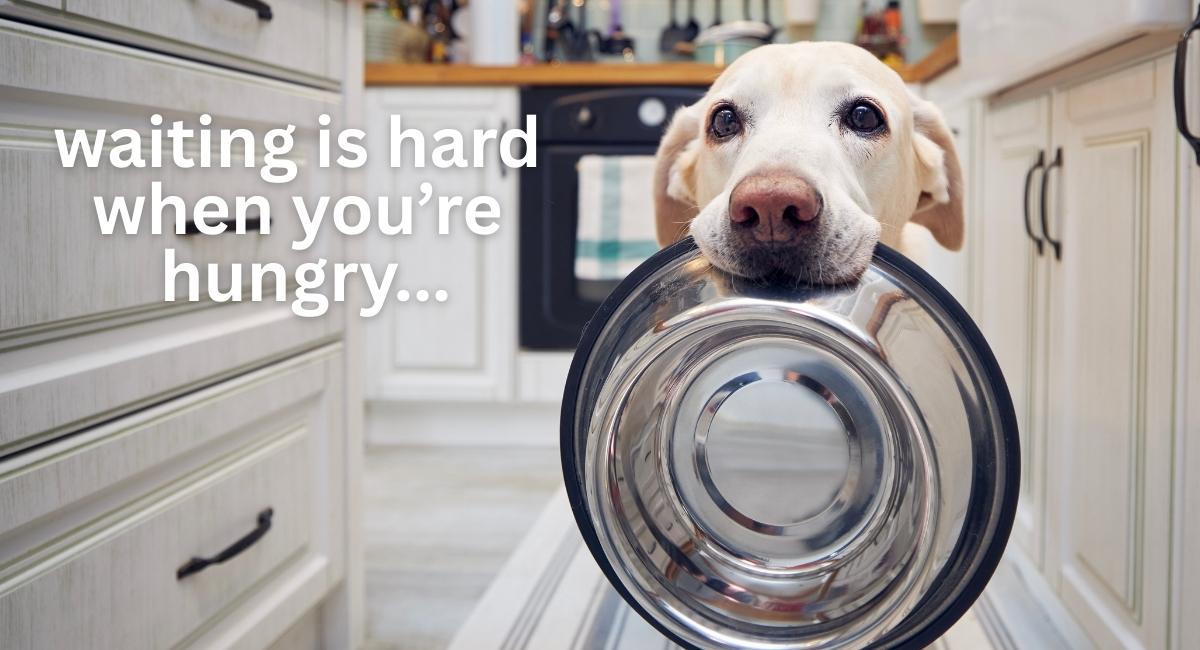
A food-obsessed dog can empty a full bowl in under five minutes, then spend the remaining twenty-three hours and fifty-five minutes scanning the kitchen for the next opportunity. That frantic pace does more than waste the sensory pleasure of eating; it makes portion control psychologically brutal because the dog's single daily highlight is over almost instantly. The fix is to restructure the meal so it lasts. Puzzle feeders — commercial products with sliding lids or rotating compartments — force a dog to work for each kibble and can stretch a meal to fifteen or twenty minutes. Scatter feeding, where the entire portion is tossed across a clean lawn or a section of hard flooring, exploits the dog's foraging instinct and produces sustained nose-down movement. Snuffle mats, essentially strips of fleece knotted into a rubber base, hide kibble in fabric folds and deliver the same slow-release benefit. Treat-dispensing balls release one or two pieces at a time as the dog rolls them across the floor. Any of these methods can be rotated to prevent the dog from mastering a single device too quickly.
Rewrite the Reward System Without Losing the Bond
Food-obsessed dogs are often deeply bonded to their owners through a shared ritual: the human offers food, the dog performs a cue, both parties feel the warmth of the exchange. Cutting calories threatens that ritual, so the replacement needs to be just as emotionally charged. Substitute part of the daily kibble allowance — up to ten percent by volume — for training rewards, and you eliminate the need for extra treats entirely. A handful of kibble delivered one piece at a time during a fifteen-minute training session gives the dog dozens of micro-rewards and reinforces obedience simultaneously. For owners who want to go further, play itself can replace food: a quick tug session or a sprint after a thrown toy can function as the reward for a sit, a stay, or a recall. The critical rule is that any reward drawn from the daily allowance must be subtracted from the portion that would otherwise land in the bowl. Without that accounting, "treats during training" simply become a second meal and the scale climbs again.
Track, Adjust, and Stay Ahead of the Plateau
Weight loss in dogs, like in humans, is not linear. The first kilogram often comes off quickly; subsequent losses slow as the body adapts to a lower intake. Reassessing the BCS every four weeks catches that plateau early enough to adjust — either by trimming a further small percentage from the daily ration or by adding a fourth short exercise session to the week. Weighing the dog on a veterinary scale (most clinics welcome walk-in weigh-ins at no charge) removes the guesswork of a bathroom scale. Print a simple progress chart: date on the left, BCS and body weight on the right, with a trend line drawn by hand. The visual record serves two audiences: it motivates the owner, and it gives the veterinarian concrete data at the next checkup. Dogs that lose five to eight percent of their starting body weight over a two- to three-month period are on a safe trajectory; anything faster warrants a conversation with the clinic. The goal is not a number on a chart but a dog that moves freely, breathes easily, and still lights up at the sound of a treat pouch — just without needing quite so many treats to do it.
Compiled from published reference material: www.thelabradorsite.com